For those of us working to make concrete printing practical, ICC 1150 gives material suppliers, printers and project teams a clearer basis for planning their work. The first edition was published in March 2026 and received ANSI approval on July 15, 2026. It is available as ICC 1150-2026, Standard for Automated Construction Technology for 3D Printing Walls. ICC committee record.
ICC covered the approval in August. We think it deserves attention for a practical reason: a dedicated wall-system standard helps teams identify the evidence they need before committing to materials, equipment and a testing program. ICC announcement.
What changes for a concrete-printing project?
ICC 1150 addresses material qualification, inspection, structural design and connections for printed cementitious walls. Its scope includes bearing, nonbearing and shear walls in one-story and multistory structures, with limitations that must be checked for the project. Layer bonding, reinforcement and connections to the rest of the building all matter. A promising compressive-strength result is useful, but the proposed wall system needs a much broader body of evidence. Official scope.
For a business developing printable materials, that makes early coordination valuable. Agreeing on the specimens, curing, test methods and acceptance requirements with the engineer and laboratory can help avoid paying for tests that do not answer the project's questions. It also makes supplier changes easier to evaluate: we can identify which evidence remains useful and what needs to be tested again.
The international connection: ISO and ASTM
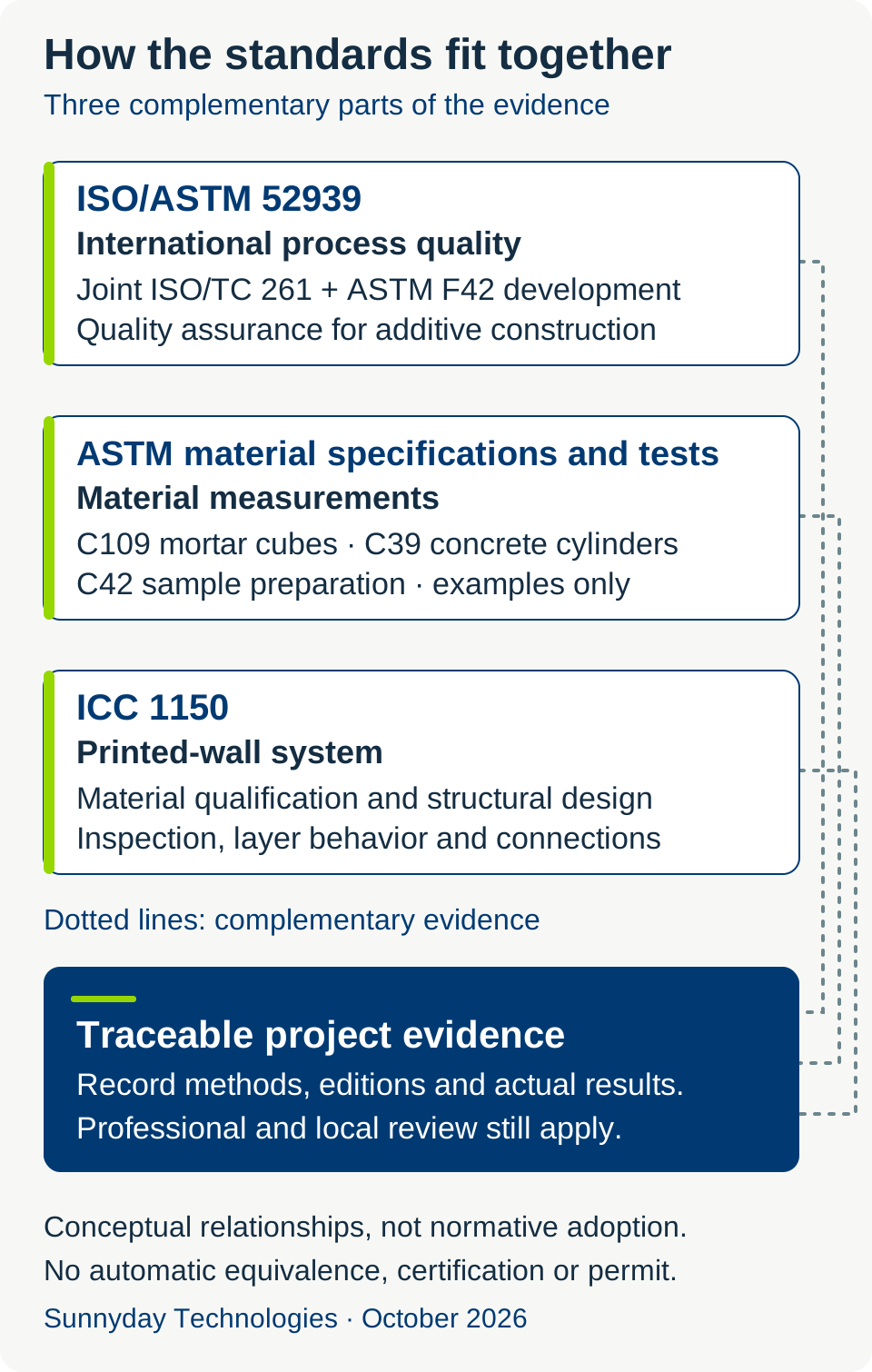
There is an established international effort alongside this work. ISO/TC 261 and ASTM F42 cooperate on additive-manufacturing standards, and the joint ISO/ASTM 52939:2023 addresses quality assurance for additive construction. Its focus is the construction process. Design approval and material-property testing sit outside its scope. ISO–ASTM cooperation; ISO/ASTM 52939 scope.
The international reach is tangible: the standard also appears as EN ISO/ASTM 52939 in Europe, including France's NF EN adoption. That provides a shared process-quality reference across markets; local building requirements still govern individual projects. AFNOR adoption record.
ASTM material specifications and test methods cover another part of the evidence. ICC's public first draft explicitly referenced familiar ASTM documents for ingredients, specimen preparation and testing. That shows the technical connection, but the published 2026 edition must be consulted for its final references, editions and procedures. We have not established that ICC 1150 formally incorporates ISO/ASTM 52939. ICC's November 2024 public draft.
What this means for testing and local materials
The test method and specimen need to stay attached to every result. ASTM C109 concerns mortar cubes; C39 concerns concrete cylinders; C42 covers obtaining and testing concrete cores and sawed beams. Those results cannot simply be exchanged because they share a strength unit. Printed layers, specimen orientation and curing add context that the project team needs to address. ASTM C109; ASTM C39; ASTM C42.
This matters commercially when sourcing local sand, cement or supplementary cementitious materials. A lower price is worth investigating, but the value depends on how that material behaves in the mix and printing process. Our approach is to keep the material identity, formulation version, mixing and printing conditions, curing history and measured results connected. That gives a supplier, printer and testing laboratory a useful record to work from when a material changes.
Where CEMFORGE and LOGiMIX fit
We see these standards as a useful direction for the industry. CEMFORGE and LOGiMIX support material decisions; our goal is to make formulation studies and their supporting records easier to compare and carry into a properly planned physical test program. Predictions require physical validation, and any commercial accuracy claim needs supporting measured data.
ANSI approval recognizes the standard's consensus process. It does not certify a particular formulation, printer or building, and it does not establish adoption in every jurisdiction. The responsible professionals and local authority still determine the requirements and approval route for the proposed project. We make no claim of ICC certification for CEMFORGE or its generated formulations. ANSI's explanation.
For us, the opportunity is straightforward: plan the testing early, keep the evidence traceable, and give local materials a fair evaluation. That is how we intend to build confidence in both the technical result and the commercial offering.